Insights
Real experiences and insights that shape outcomes

Blockchain has been a buzzword for some time, and the real question in people’s minds is, “How far is blockchain from becoming part of mainstream applications? First, where and when can we use Blockchain, and how mature is it? Grep Digital is working on blockchain applications & use cases, and we will try to answer those questions here.
Blockchain technology is around for more than a decade and has proven its potential for a wide range of applications. However, it has not yet been widely adopted in mainstream applications. This is partly due to the complexity of the technology and the challenges associated with implementing it in existing systems.
Blockchain is often compared to the Internet and is considered an integral part of the Internet chain. While the communication mechanisms are similar, the key difference is that Blockchain is used for value transactions. The Internet is used to exchange information.
So what value are we talking about? It can be actual or fictional. In this new age where “everything is offered as a service,” the concept of value, real or fictional, is indispensable. That’s why blockchain lends itself to many of these services.
While the blockchain is the framework on which cryptocurrencies are developed, it also has its own value and exciting features. These important properties are
The main reason is a lack of awareness and understanding. Second, there is a reputation problem, as blockchain is a synonym with the crypto world. Users perceive it as a place for bad actors, hackers, scammers, and speculators.
One of the biggest challenges in using blockchain technology in general applications is the scalability of the underlying networks. Current blockchain networks, such as the cryptocurrency Bitcoin, are unable to process a large number of transactions for mainstream applications. Lightening Network came up with a design to improve scalability and make the technology more suitable for mainstream use.
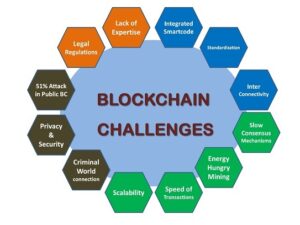
One of the key challenges to using blockchain technology in mainstream applications is the lack of standardization. It is difficult for companies and organizations to choose the right one from different blockchain platforms. This lack of standardization can also make it difficult to integrate blockchain technology into existing systems and processes.
Other reasons are largely technical:
In addition, blockchain has an impact on the environment and incurs costs. The high-intensity computations consume a lot of energy. The original consensus mechanism for validating transactions was Proof of Work, which was very energy intensive. The newer “Proof of Stake’ mechanism reduces energy requirements by more than 90% and has provided some relief.
Despite these challenges, there are many potential benefits to using blockchain technology in common applications. For example, it provides a high level of security and transparency. This can automate complex business processes and reduce the need for intermediaries. As technology continues to improve, will see more and more mainstream applications of blockchain technology in the future.
The tech world is becoming aware of the positive attributes of blockchain and the impact it can have in terms of decentralizing data and applications. Large investments are flowing into overcoming the problems mentioned above. There are now enterprise-grade blockchain platforms that scale well and are very powerful in government and financial institutions. They can quickly integrate with other Web2 or legacy applications. This opens up a new world of applications that leverage the unique properties of blockchain to provide greater security, accessibility, and decentralization.

One of the key enablers to the widespread adoption of blockchain is the development of decentralized financial platforms (DeFi). These platforms enable the creation of decentralized financial instruments, such as loans and stablecoins. Smart contracts define the constructs and are not under the control of a single entity.
The increasing use of blockchain in various industries led to the development of specialized solutions tailored to the specific industry. For example, blockchain-based solutions now exist for supply chain management, medical record keeping, and identity verification.
New protocols and algorithms such as proof-of-stake and sharding have improved the scalability and performance of blockchain networks. This has enabled the creation of high-throughput networks that can handle large numbers of transactions without compromising security or decentralization.
Blockchain technology has come a long way in recent years, with numerous advances and innovations. They have made it more secure, scalable, and efficient. As a result, it is ready for mainstream applications in various industries, including finance, healthcare, supply chains, and government. Overall, advances in blockchain technology have made it ready for mainstream applications, as it can provide secure, transparent, and decentralized solutions for various industries. To read more on how blockchain is taking strides in the fintech industry refer to the article The Revolution in Fintech is Near: How Will Blockchain Change the Industry? – (grepdigital.com)
R3 Corda is one such example of a platform that solves most of the above problems.
Grep Digital is using Ethereum, R3 Corda, and ConsenSys to develop applications in the fintech and e-governance sectors. Connect with us to partner in your blockchain solutions journey.
“Exploiting blockchain will demand that enterprises be willing to embrace decentralization and strategic tokenization in their business models” (gartner)

The Internet of Things (IoT) ecosystem is evolving rapidly, with billions of connected devices generating massive streams of data. Due to increase in deployment of IoT ecosystem ac
Read more
Ethereum vs Solana vs Polygon Consensus It is one mandatory procedure for all the decentralized blockchain platforms. It is what helps to reach an agreement on the present
Read more
Introduction Secure Software Development Lifecycle (SDLC) is a systematic approach to developing software that emphasizes security from the beginning and throughout the entire dev
Read more
Introduction In the world of natural language processing (NLP), two technologies that are currently making headlines are LaMDA and ChatGPT. Both of these technologies are enable c
Read more
Metaverse - in simple words is a virtual world (Digital World). It is experienced and built based on Virtual Reality and Augmented Reality. Use of Blockchain in Metaverse
Read more Technogrep Solutions LLP
HD-022, WeWork Pavilion,
62/63 The Pavilion Church Street,
MG Road, Bangalore,
India-560001
✉ info @ grepdigital.com
