Insights
Real experiences and insights that shape outcomes

Is cloudification a boon or bane? Businesses are moving to the cloud to embrace and adopt new technologies. The existing applications move from on-premises into cloud. Businesses use these applications actively in the day-to-day operations. The others are in the development or design phase. To ensure minimum disruption, enterprises take a decision to “lift-n-shift” model to deploy into cloud. The other applications that are in the development phase use IaaS or PaaS platforms, taking into account resource requirements and usage patterns. In most cases, enterprises continue to have physical infrastructure and operate in a hybrid cloud model.
Enterprises start seeing the of moving to the cloud in the first few years with substantial cost savings. Most of the investment costs are converted into opex and cloud service users get accustomed to the flexibility and on-demand nature of cloud fulfilment.
Over time, IT and the finance department observe a steady increase in cloud operations costs that exceed budgeted expenses. Common analytics and remedies include stopping unused and unresponsive server instances, creating better alerts, leveraging the cloud provider’s auto-scaling, monitoring cloud traffic, buying spot or spare instances, switching to serverless computing and more.
All of these are viable options that you can use to reduce your expenses. But is it sustainable in the long run? Enterprises must take a systematic approach to cost reduction by categorizing and analyzing the various operations within the stakeholders. So, what can you do to make it sustainable?
According to a report from Gartner, companies need to develop financial management processes. These processes involve multiple roles and departments, including Infrastructure & Operations (I&O), the Cloud Center of Excellence (CCOE), Finance and first-hand users of cloud services. Ultimately, these processes lead to new management requirements and require the introduction of new tools.
A cloud cost management structural framework provides a guide not only for operational aspects, but also for architecture, application development, and DevOps. Applying this methodology can initiate a culture change that makes cloud users more accountable for their IT spending. Ultimately, it can help you learn how to manage costs in relation to the business value that cloud services generate.
Managing cloud costs requires the development of capabilities in five distinct areas:
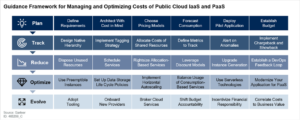
This framework is provider-neutral and can be applied to all major cloud providers including the hybrid cloud offerings. For this model to work, technical professionals must complete some fundamental prework:
The 6 disciplines are

Owning the cost management process doesn’t mean having to execute first-hand each of the listed practices. Distribute the execution among the stakeholders. Define and enforce the cost policies. Define the policies transparently and in collaboration with the identified stakeholders and let CCOE make the “final call” on it.
When implementing cost management, companies can leave responsibility for spending to the I&O team for an initial – and limited – period of time. This approach will help accelerate the implementation of potentially disruptive processes, such as resource release or decommissioning. Applying this guide in its entirety will decentralize and distribute responsibility for cloud spend across all teams responsible for delivering cloud applications and projects in the future.
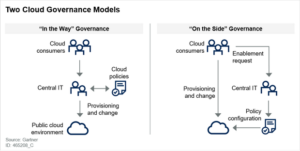
Gartner recommends the use of “On the Side” governance model which provides flexibility to the Line of Businesses to plan and manage the cloud spend. All stakeholders employ the cost reduction techniques in the context of this framework to meet the intended goal.
At Grep Digital, we look at all the above parameters when suggesting a technology path. Contact us for more such fundamental decision points that need to be taken during a technology implementation.
Credits: Gartner Research Articles, Mckinsey Articles

Modern solar energy environments continue to grow in complexity. Solar generation, grid supply, battery storage, and generator backup now operate as a single interconnected system.
Read more
Introduction Data Management Solutions play and important role in meeting the net zero targets. In the global quest to combat climate change, green energy utility providers play a
Read more
Introduction Businesses today are constantly seeking ways to streamline operations, enhance productivity, and create more engaging environments for people, employees and clients a
Read more
Introduction Conversational bot is one of the most exciting applications of NLP is the development of interactive and intelligent bots. These bots have the poten
Read more
Introduction In today's digital landscape, where data breaches and cyber threats are prevalent, ensuring robust cybersecurity measures is crucial for protecting sensitive informat
Read more Technogrep Solutions LLP
HD-022, WeWork Pavilion,
62/63 The Pavilion Church Street,
MG Road, Bangalore,
India-560001
✉ info @ grepdigital.com
